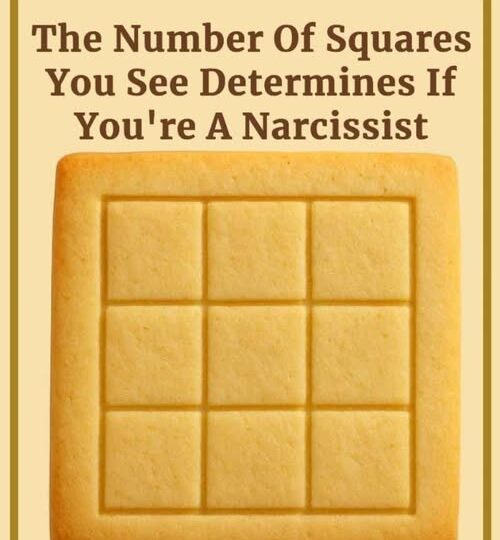
A seemingly simple grid image has captivated thousands across social media platforms, transforming a basic visual into an interactive exercise that encourages users to engage, count, and reflect on their own cognitive approach to challenges.
The puzzle’s caption reads: “The number of squares you see determines if you’re a narcissist.” This playful framing instantly alters perception, turning a basic geometric pattern into a personal and psychological experiment.
What begins as a casual glance quickly evolves into a detailed task. Viewers start counting, re-counting, and verifying, often comparing results with friends online, creating widespread discussion across social networks.
Its viral nature stems from its perfect blend of simplicity and curiosity. A single line of text paired with a visual challenge taps into a universal desire to explore self-awareness, even in a lighthearted context.
The Psychology Behind Immediate Engagement
Human beings naturally seek insight into themselves. Even trivial tasks become meaningful when paired with personality labels, encouraging individuals to invest attention and effort into seemingly simple challenges.
The combination of counting with a playful psychological claim adds intrigue. Participants are not only recognizing shapes—they are evaluating what their observation might imply about personality traits.
Before counting begins, viewers may subconsciously question themselves. Could their perception indicate something deeper? This subtle prompt engages the mind even before action starts, enhancing the puzzle’s appeal.
The puzzle functions as more than entertainment. It becomes a mirror of cognitive style, drawing attention to perception habits, attention to detail, and how individuals approach problem-solving in daily life.
Step One: Counting the Squares
Initial observation often reveals nine obvious squares. These smaller shapes, clearly defined and evenly arranged, are immediately visible and easily counted by most participants without extensive analysis.
Closer inspection reveals additional, larger squares formed by combining sections. Awareness of these hidden shapes requires careful focus and patience, testing an individual’s attention to layered structures.
Eventually, the entire grid itself forms a single large square, bringing the total to 14. Achieving this number requires both persistence and an ability to consider relationships between individual elements and the whole structure.
